WORLD CUP 2026
FACES FAN EXODUS
$20 BILLION U.S. IMPACT AT RISK
Sold to America as a $30.5 billion miracle. Six weeks out, hoteliers, host cities and the fans who bleed for this game say $20 billion is already walking out the door.
This is a Cabo Verdean writing about Cabo Verdeans. The Tubarões Azuis qualified for our first-ever World Cup. Our parents and grandparents saved for this for decades. And the United States — the country many of us call home — has decided we look like a flight risk worth $15,000 to bet on. Sit with that.
Igrew up watching Cabo Verde's national team play on borrowed feeds, on phones held up to laptops, in living rooms in Brockton and Pawtucket and Boston where the WhatsApp group chats moved faster than the broadcast. We never had a World Cup. We have one now. We should be on a plane. Instead my cousins in Praia are doing math on kitchen tables, and the math comes out the same every time: $15,000.
That is the refundable "visa bond" the U.S. State Department's pilot program can demand from Cabo Verdean nationals — and from citizens of roughly fifty other countries deemed "high-risk" for visa overstays. For families on an island chain where the median household earns a fraction of that figure in a year, the bond is not refundable. It is impossible. And while consular officers may choose $5,000 or $10,000 in some cases, every one of those numbers is a closed door dressed up as a deposit slip.
FIFA promised "the World Cup the world has been waiting for." The world is now waiting at the U.S. consulate. And many of them will not get there in time.
THE $15,000 WALL — WHO PAYS IT
Per Condé Nast Traveler, Sports Illustrated and Fragomen's advisory, the bond falls hardest on five qualifying World Cup nations whose citizens must apply for full visitor visas rather than the $40 ESTA most Europeans and Asians enjoy. These are not "tourists." These are families. These are uncles who have sent money home every month for thirty years for a moment exactly like this one.
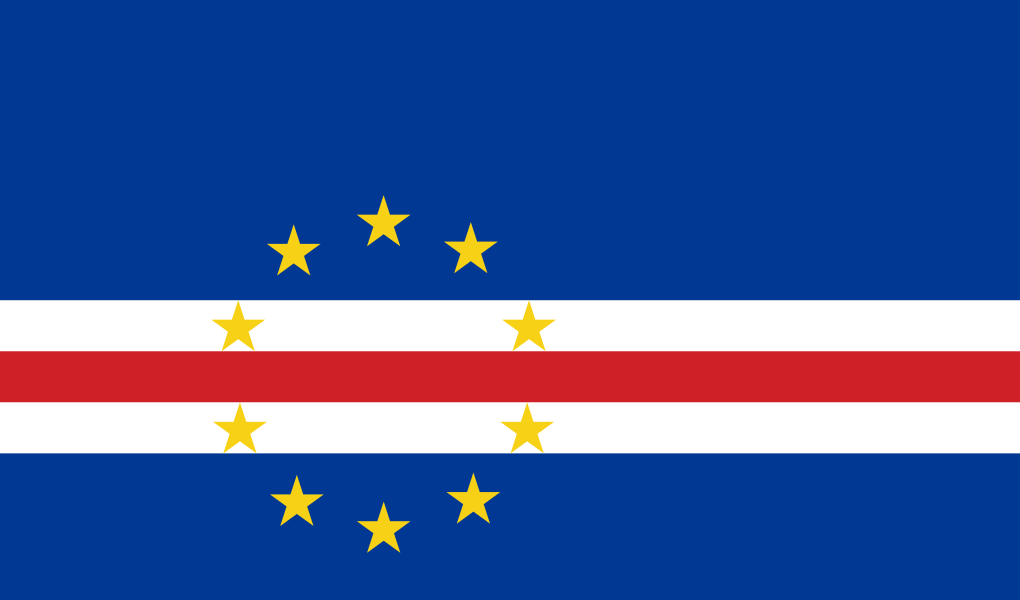 Cabo VerdeUP TO $15,000
First-ever World Cup. 560,000 people. Diaspora locked out.
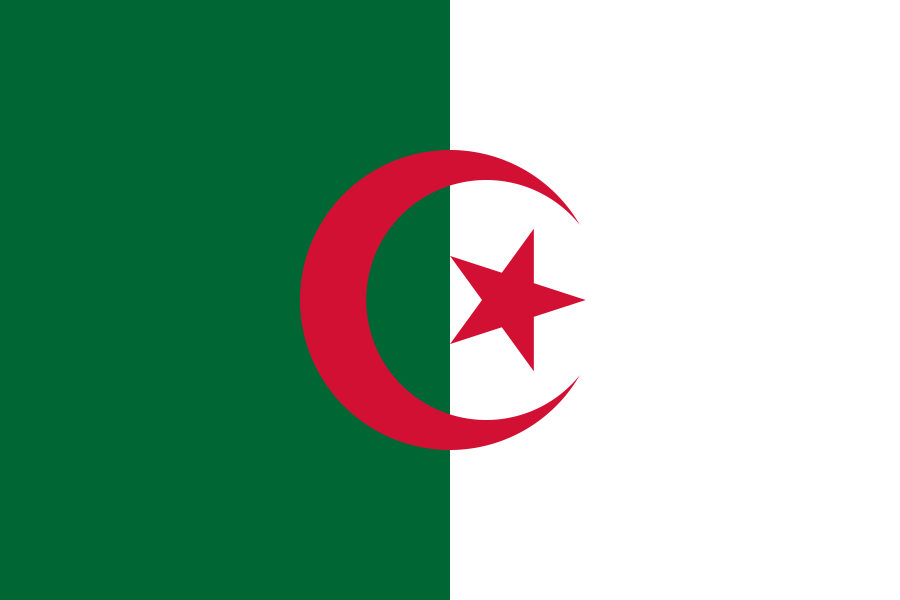 AlgeriaUP TO $15,000
Desert Foxes faithful priced out before kick-off.
 Ivory CoastUP TO $15,000
African champions fans hit with travel-ban overlap.
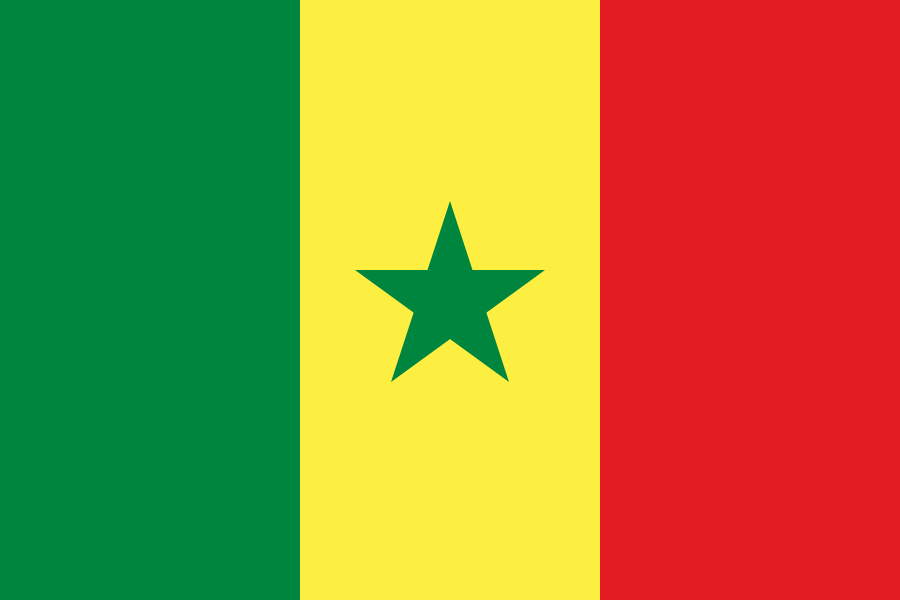 SenegalUP TO $15,000
Lions of Teranga supporters facing both bond and ban.
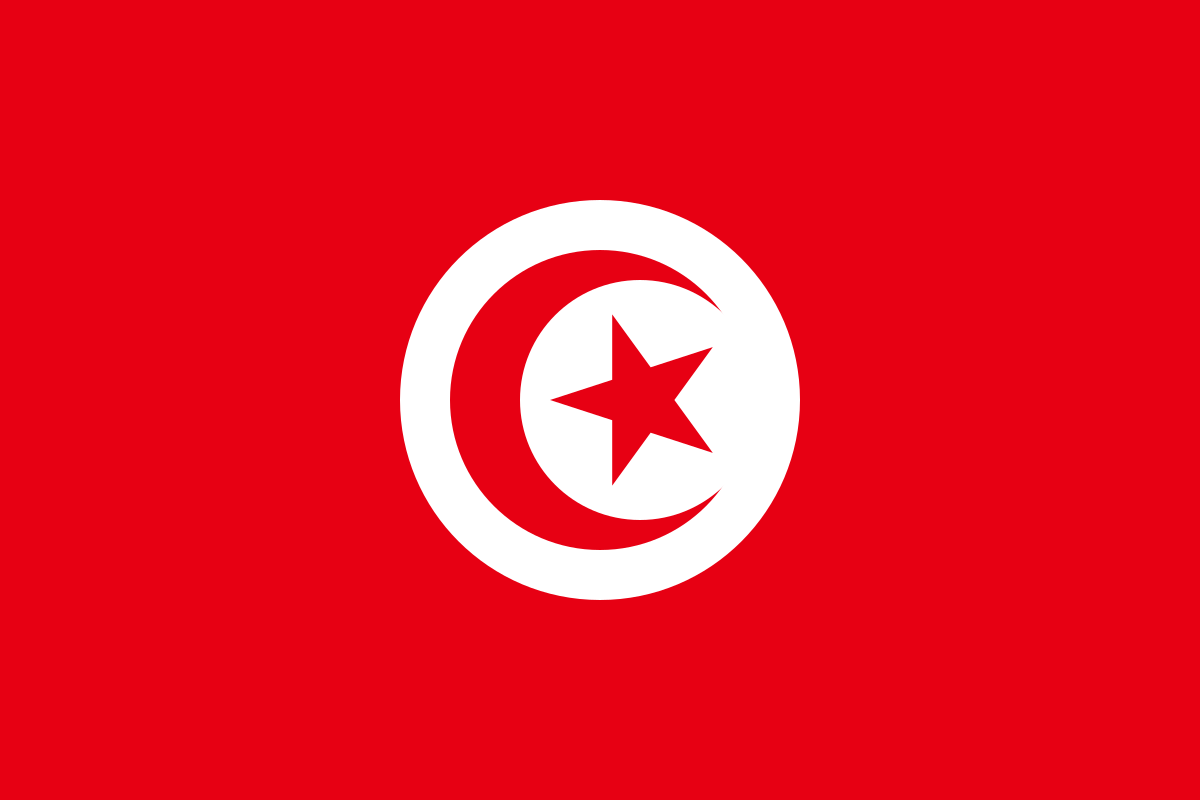 TunisiaUP TO $15,000
Carthage Eagles families forced to choose between rent and a bond.
Layer the bond on top of the existing travel bans — Haiti, Iran, Ivory Coast, Senegal — and a chunk of the planet that lined the streets to celebrate qualification has effectively been told: not you. The Council on Foreign Relations has documented the overlap. More than 100 civil-rights groups have issued a travel advisory warning international fans of invasive social-media screening and aggressive ICE presence at tournament sites. NPR and The New York Times' Athletic FC reporting calls it a "Trump Slump" and a 5.5% projected decline in international visitors. Whatever you call it, the seats it leaves empty are real.
THE HOTELS KNEW BEFORE WE DID
On May 4, 2026, the American Hotel & Lodging Association (AHLA) published the survey that turned a whisper into a siren. Nearly 80% of hoteliers in the eleven U.S. host cities reported bookings "well behind" expectations. Roughly 70% cited visa barriers, geopolitical tensions and brutal airfare/hotel pricing as the deterrent. Roughly 70% said FIFA quietly released or cancelled large early room blocks, flooding the market and turning the predicted group surge into ordinary July inventory. CNN, MSNBC, NPR and the New York Post all carried versions of the same headline this week: not coming to America.
- Kansas City85–90% behind
Hoteliers report bookings well below expectations; fans drifting to coastal markets.
- VancouverCritical shortage
~22,700 rooms; 70,000-night deficit. Min-stay rules in 95% of hotels.
- Mexico City+2,373% rate hike
Opener week — $157 rooms listed near $3,900. Demand up 114% YoY; only 36% confirmed.
- Toronto+78% avg. rate
Moderate price hikes vs. Vancouver but limited availability and minimum stays.
- New York / NJHighest U.S. premium
NYC leads U.S. host cities on rate; soft confirmed bookings even at the top of the market.
- Atlanta · Dallas · Houston70–80% occ.
On par with a normal summer — not the surge hotels priced for.
Vancouver is the inverse problem and the same story. The city has roughly 22,700 rooms and a documented shortfall north of 70,000 overnight stays. Up to 95% of its hotels have imposed length-of-stay minimums that force a single-match fan to book three nights minimum. Mexico City has rooms — and is charging 2,373% above baseline for the opener. A normal $157 room is listed near $3,900. Demand in Mexico City is up 114% year-over-year, but only 36% of those rooms are confirmed. Even there, fans are waiting on logistics that may never make sense.
THE TICKETS NO ONE CAN AFFORD
FIFA has officially sold over 5 million tickets, and the front of the press release will keep saying so. Read deeper: more than 80 matchesstill have inventory in last-minute sales. Only 17 of the 104 matches are confirmed sold out. The U.S. opener at SoFi Stadium — 70,000-plus capacity — was sitting at roughly 40,934 tickets sold in mid-April. The cheapest "Category 3" seat for that match was listed at $1,120. The semifinal? Up to $11,130. FIFA's "variable pricing" model, with new "front category" tiers, has done what critics warned it would: priced the working fan out of the tournament FIFA insisted was for them.
- USA vs. Paraguay (Opener)$1,120 – $4,105
SoFi Stadium · Los Angeles
- Argentina vs. Austria$2,475 – $2,925
Arrowhead · Kansas City
- England vs. Croatia$2,505
AT&T Stadium · Dallas
- Tournament Semifinal$9,660 – $11,130
Dallas / Atlanta
FIFA continues to warn that the only legitimate resale channel is the Official Ticket Marketplace — fair enough, the secondary market is a minefield. But warning fans about scammers does not answer the bigger question: who is the market? With international travel down, domestic ticket buyers will outpace international visitors for the first time in modern World Cup history.
CANADA & MEXICO — SAME STORY, DIFFERENT BORDERS
Lest anyone pretend this is a U.S.-only failure: a fan crossing into Canada pays roughly CAD $100 for a visitor visa (CAD $7 for an eTA), plus CAD $85 if biometrics are required. Mexico generally charges $36–$40 for a visitor visa, though many fans with valid U.S. or Canadian visas can enter free. The continental ticket — one tournament, three countries — was the romantic pitch. The romantic pitch did not include three border lines, three security regimes and three room markets that all decided to spike at the same time.
WHAT WE LOSE
The U.S. was promised a $30.5 billion tournament. Industry analysts now believe the country could leave $20 billion of that promise unrealized — money that was supposed to land in housekeepers' tip jars, in airport-shuttle drivers' pockets, in the first-generation restaurants in Newark and Inglewood and Kansas City that hung the qualifying nations' flags in their windows the day the brackets dropped.
And those of us in the diaspora? We lose something the spreadsheets can't price. We lose the moment our fathers prayed to live to see. Cabo Verde — ten islands, 560,000 people, our first World Cup — and the country that took us in when we left has decided we cost $15,000 to trust. I will never make peace with that sentence.
The tournament will still happen. SoFi will still light up. Azteca will still shake. Somewhere, a Brazilian who got an ESTA in forty-eight hours will sit next to an empty seat that was supposed to belong to a Cape Verdean grandfather, and neither of them will know the seat had a name. Football is supposed to be the small religion of the world. In June, you will be able to count, in empty chairs, exactly how much of the world America decided it could afford to leave outside.
FROM THE HEART
I have to stop the editorial voice for a minute, because there's too much on my heart to keep it tucked behind the policy sentences. I have to write this part out plain.
CABO VERDE 🇨🇻 — ten islands, 560,000 people at home, and a diaspora that has been waiting our whole lives for this. Our grandparents left Mindelo and Praia and Brava with cardboard suitcases so that one day their grandchildren could stand in a stadium and hear our anthem played at a World Cup. They left on boats that did not promise a return, raised children across oceans, and buried more dreams than they ever got to keep. Most of them did not live to see this day. June 15 is that day anyway — and we carry every one of them onto the pitch with us. Whether you watch it from a stadium seat, a Brockton living room, a Lisbon café or a fishing boat off Sal — you are the team. You always were. Crioulos, this one is for the ones who never got to see it.
HAITIAN BROTHERS & SISTERS 🇭🇹 — you qualified through fire. Through a federation that played home games away from home, through earthquakes and hurricanes and a country that has been told too many times to wait its turn. Les Grenadiers earned that crest the hard way. When you walk out at this World Cup, every Cape Verdean I know will be standing too. We see you. Same ocean, same scars, same joy. Ayiti, n'ap kanpe avèk nou.
And for me, this isn't abstract. We have been one ever since I met a dear friend — to me and to many — Pierre François, back in 2nd grade at the Harrington School. Cape Verde and Haiti shared a hallway long before they shared a World Cup bracket. That bond didn't start in June 2026. It started at recess, in a Cambridge classroom, in lunch trades and in two kids who already knew the islands their families came from were closer than the maps let on. So when Les Grenadiers take the field, I'm not cheering for strangers. I'm cheering for Pierre, and for every kid like us who grew up two flags deep.
SENEGALESE FAMILY 🇸🇳 — you are not cousins to us, you are family. The Lions of Teranga taught a whole generation what African football looks like when it walks in like it owns the room — because it does. Dakar to Praia is a short flight and a shared coastline; teranga is the same word in any language. Whatever group you draw, whatever bond they ask you to post, the Cape Verdean section will be loud for you too. Jërëjëf for showing the rest of us how to believe.
IVORY COAST · DISTANT COUSINS 🇨🇮 — Les Éléphants. AFCON champions on home soil — we watched every minute of that final and cried like it was ours, because in a way it was. West Africa raised half the players we love. Abidjan raised half the rhythm we listen to. If we meet on the pitch in this tournament it will be a privilege; if we don't, we'll meet in the bracket of every neutral fan with taste. Akwaba — and forçaaa.
To all of us — Cabo Verde, Haiti, Senegal, Côte d'Ivoire, and every nation a $15,000 bond tried to keep outside the gate: the game does not belong to the country that prints the visa. It belongs to the people who sing through it. We will sing. Loud enough for the empty seats. Loud enough for the grandparents. Loud enough that the spreadsheet hears us.
Tubarões Azuis. Forçaaa. We will be loud enough for the cousins who couldn't come.
— Nelito ("Lito"), CV Sports HQ
- · TravelAge West — Weak Hotel Demand in U.S. World Cup Cities
- · New York Post — Why International Fans Are Skipping the U.S. (May 4, 2026)
- · CNN.com — World Cup 2026 hotel & travel coverage
- · MSNBC.com — World Cup 2026 visa & travel-ban reporting
- · American Hotel & Lodging Association (AHLA), May 2026 host-city survey.
- · Council on Foreign Relations — "The U.S. Is Co-Hosting the FIFA World Cup. But Much of the World Can't Come" (Apr 15, 2026).
- · Condé Nast Traveler — "Some World Cup Fans Could Be Required to Post 'Visa Bonds' Up to $15,000" (Apr 2, 2026).
- · Sports Illustrated — "Why Some Players May Have to Pay $15,000 Bond" (Mar 26, 2026).
- · Fragomen — "U.S. Visitor Visa Rules for the 2026 FIFA World Cup" (Feb 3, 2026).
- · The Athletic FC / NY Times — "The myth of the 2026 World Cup hotel and tourism boom" (Apr 22, 2026).
- · NPR — "Hotels have a big World Cup problem: bookings far below projections" (May 4, 2026).
Tubarões Azuis. Forçaaa. We will be loud enough for the cousins who couldn't come.